


Guest Post by Willis Eschenbach (@WEschenbach on X, my personal blog is here)
I got to thinking about how much the world will warm in the long run when the radiation absorbed by the surface increases. I figured I could use that to estimate the long-term climate sensitivity, which is usually expressed as how much the surface will warm if CO2 doubles. (2xCO2).
To begin with, I looked at the total amount of power absorbed by the surface, in watts per square meter (W/m2). This includes solar radiation from the sun, longwave radiation from the atmosphere, and advected heat, which is the power constantly being moved horizontally from the equator to the poles. Fig. 1 shows the result, both without (left) and with (right) advected heat. Note how the poleward advection of heat evens out the heating of the planet.
Figure 1. Surface power absorption both without (left) and with (right) advected power.
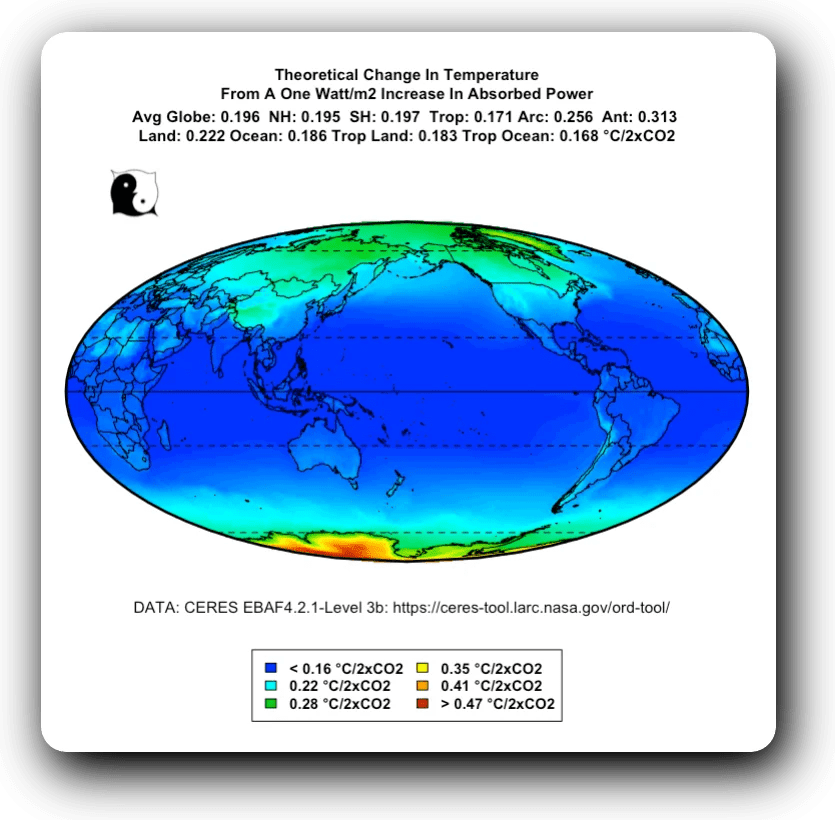
Now, the Stefan-Boltzmann equation relates radiated power to temperature. The formula says that the radiated power is a constant times the emissivity of the surface times the fourth power of the temperature. So … given that equation and the temperature of the Earth, how much should an increase of 1 watt per square meter (W/m2) warm up the planet? Figure 2 shows the calculated result.
Figure 2. Calculated theoretical temperature change using the Stefan-Boltzman equation, on the order of 0.2°C per W/m2. (Thanks to Arjan Duiker who pointed out below that the legend in the graphic is wrong, it should be C per W/m2.)
Note the variations in the calculated temperature changes due to temperature and emissivity. As expected, because of the fourth power relationship, a one-watt per square meter change makes more difference at the poles than in the tropics.
Next, I looked at the real-world relationship between the net absorbed power (including advection) and the temperature. Fig. 3 shows the result as a scatterplot of the temperature versus the total absorbed power.
Figure 3. Scatterplot, surface temperature versus net gridcell power absorption (including advection)
Note that the slope (trend) of the yellow line is the sensitivity of temperature in °C with regard to the net power absorbed by the gridcell.
This is a most interesting graph. First, the slope is almost constant from the extreme cold of the south pole up to about 26°C. This is a surprise, because the Stefan-Boltzmann equation would lead us to think the sensitivity should be greater in the cold regions. But apparently, this is offset by the advection of heat from the tropics to the poles.
Second, the clustering is very tight. This shows the close relationship between absorbed radiation and temperature at all levels of radiation.
Third, the slope goes almost flat at the highest temperatures. This means that no matter how much additional power is going to the warmest gridcells, they are not warming any further.
To understand more about the slope, Fig. 4 shows the slope overlaid on Fig. 3 along with the average value.
Figure 4. As in Figure 3, but with the red line showing the slope of the yellow trend line (right scale) and the area-weighted average trend.
A question arises. Is this average slope of ~0.14°C per W/m2 just a one-off, or is this a more permanent feature of the Earth’s climate? Will it change if the total power absorbed by each gridcell increases due to any reason?
To investigate that, I looked at the 25 individual years of CERES data. To start with, here’s the range of the gridcell absorbed power over the 25 years.
Figure 5. Boxplot, range of gridcell power absorbed by each of the 25 years of the CERES data.
Note that the range goes from 507 W/m2 up to 513 W/m2, a range of 6 W/m2. This is far more than the expected change from CO2.
Now look below at how small the change is in the expected sensitivity of temperature to surface power absorption.
Figure 6. Boxplot, range of temperature sensitivity for each of the 25 years of the CERES data.
Above, I rounded the sensitivity to 0.14°C per W/m2. Despite the absorbed power varying by 6 W/m2, the calculated average sensitivity only varies from 0.133 to 0.140°C per W/m2. This is small enough to be lost in the noise. So we can see that this relationship between temperature and gridcell absorbed power is a stable feature of the climate.
So … how does this all relate to the equilibrium climate sensitivity? To calculate that, we need to take a look at how the changes in the poorly-named” greenhouse radiation” relate to downwelling longwave at the surface. In other words, if the greenhouse radiation increases by 1 W/m2, how much does the downwelling radiation at the surface increase? Once again, I turn to the CERES data. Fig. 7 shows the result.
Figure 7. Scatterplot, surface downwelling longwave radiation versus top-of-atmosphere (TOA) “greenhouse” radiation.
Now we can put it all together:
Change in surface temperature per 1 W/m2 gridcell power absorption = 0.14 °C per W/m2
Change in TOA downwelling “greenhouse radiation” per doubling of CO2 = 3.7 W/m2 per 2xCO2
Change in gridcell power absorption per 1 W/m2 TOA “greenhouse” radiation = 1.46 W/m2 per W/m2
Expected change in temperature from a doubling of CO2 =
0.14 °C per W/m2 times 3.7 W/m2 per 2xCO2 times 1.46 W/m2 per W/m2 =
0.75°C per 2xCO2
Uncertainty analysis: the uncertainty in the slope can be estimated by taking the standard deviation of the slopes of the 25 individual years making up the average slope shown in Fig. 3. This is 0.006 °Cper W/m2. This also shows the temporal stability of this type of analysis
The uncertainty in the change in downwelling surface radiation is 0.069 W/m2 per W/m2.
The uncertainty in the estimated increase in CO2 forcing from a doubling of CO2 is 0.35 W/m2
Combined, this gives a final value of the climate sensitivity estimate of:
0.76 ± 0.08 °C per 2xCO2
I note that in my post …
… I had calculated a maximum estimated climate sensitivity of 1.1°C per 2xCO2. I said it was a maximum because it did not include the moderating effect of clouds and other phenomena on the changes.
This current estimate of 0.76 W/m2 per 2xCO2 includes not only clouds but all other weather phenomena that affect the sensitivity. So I would say that it is a best estimate, rather than a maximum estimate.
As always, comments and corrections welcome.
My best to all,
w.
My Customary Ask: When you comment, QUOTE THE EXACT WORDS you are referring to. I can defend my own words. I can’t defend your interpretation of my words. Thanks.