

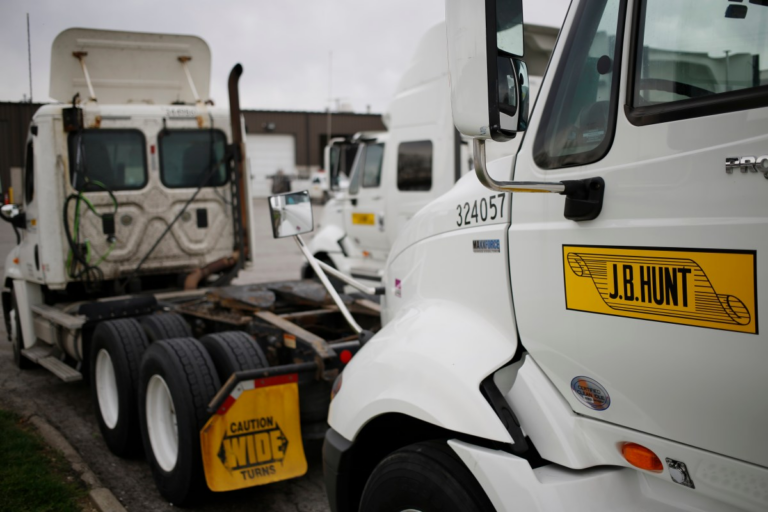
Transportation and freight network giant J.B. Hunt is searching for software and digital products that will fuel its business and help it adapt to the modern world — and even dominate the industry. And it’s tapping startup incubator UP.Labs to help build them.
On Wednesday at the UP.Summit event in Bentonville, Arkansas, the two companies announced a logistics and freight venture lab that will launch up to six startups over the next three years. The first of these startups is slated to launch in 2025 and will focus on some of the biggest problems in logistics and freight.
UP.Labs isn’t structured like the many startup incubators that exist today. And while the company does operate in parallel with venture firm UP.Partners and uses some underlying concepts found in the venture capital world, it is not a traditional VC firm.
Instead, UP.Labs is a venture lab with a financial investment vehicle. The company forms agreements with major corporations to solve a problem for that company and for the wider sector. These aren’t meant to be proof-of-concept ideas. Instead, these startups are designed to operate independently and commercially.
Importantly, UP.Labs doesn’t allow the corporate partner to invest more than their pro rata in any of the financing rounds because it can make it difficult to attract talent and future investors. After three years, the corporate partner has the option to acquire the remaining shares of the startup. They will use a third-party valuation firm to determine the fair market value.
The opportunity to develop logistics startups focused on software and data is vast, UP.Labs founder and CEO John Kuolt told TechCrunch in a recent interview.
This is the third venture lab launched by UP.Labs and a major corporation since it launched in 2022. Its first partner was Porsche, which represents the automotive sector. Under that partnership, several startups have launched, including Pull Systems, which developed performance management software for EV suppliers, manufacturers, and operators. The lab also created Sensigo, a startup that is working on software to help service technicians diagnose problems in modern, software-defined vehicles in a matter of minutes, instead of days.
Last year, UP.Labs formed an aviation-focused lab with Alaska Airlines. Odysee, the first startup born out of that lab, made its public debut at the UP.Summit.
Overall, UP.Labs has launched 10 companies — including four with Porsche and two with Alaska Airlines — in the past 2.5 years, according to Kuolt.
“Startups are not new for us,” J.B. Hunt president and CEO Shelley Simpson said at the UP.Summit, noting the business has transformed from a legacy truck carrier to being one of the largest transportation logistics companies. That transformation required innovation within the company and tapping outside partners. For instance, Walmart, Tyson Foods, and J.B. Hunt partnered in 2019 with accelerator network Plug and Play to set up a logistics-focused program in Northwest Arkansas.
What’s different this time, she said on the sidelines of the UP.Summit event, is how this venture lab operates.
“We don’t think we’re the ones who can solve everything,” Simpson said. “We recognize the market is very large and we certainly think we have good, smart people, but we also know there’s really smart people out there, and anytime we can find a good partner, that’s going to be important for us.”
J.B. Hunt and UP.Labs launch venture lab to build logistics startups
Gary council approves public transportation budget, postpones items
The Gary Common Council on Tuesday approved the city’s public transportation budget, which stayed the same compared to 2024.
The council also postponed multiple budget items, including for the Gary-Chicago Airport Authority, stressing that more discussions are needed before they sign off on them.
The Gary Public Transportation Corporation’s 2025 budget is $15,327,703. Council members unanimously approved the budget.
Councilwoman Mary Brown, D-3rd, was absent from Tuesday’s meeting.
The bulk of the transportation budget will go toward personal services, with about $8 million. Full-time salaries are estimated to cost about $4.9 million, and the department isn’t expected to pay part-time wages, which cost more than $81,000 in 2024.
Full-time salaries will cost more than $500,000 less than the previous year, and personal services will cost about $1.9 million less than 2024, according to the ordinance.
“We cut our payroll expenses now so that we can move those funds toward our capital projects because we’re trying to rebuild our fleet and rebuild our facility,” said Freddy McMillon, finance director for the Gary Public Transportation Corporation. “We are trying to move diligently. … We’re having a good year, and we expect a really great year next year.”
The transportation department is allocating more than $4.5 million toward capital expenses, including land, building improvements and machinery. The amount is about $1.8 million more than the 2024 budget amount, which was about $2.7 million.
The department is expected to spend about $134,000 more on supplies, including gasoline and diesel, garage and motor supplies, and chemical supplies.
According to its budget, the transportation department’s maximum estimated funds to be raised is $3,970,309, which is the amount of the current tax levy. Cutting payroll expenses helps save taxpayers money, McMillon said at Tuesday’s meeting.
Denise Comer Dillard, interim general manager for the Gary Public Transportation Corporation, said the department has successfully expanded partnerships and expects to continue in 2025.
Comer Dillard highlighted the city’s partnership with Greyhound Lines, which has begun routing more buses to Gary. Buses are routing to the metro center, and Greyhound has about 25 arrivals and 30 departures.
The transportation department started with about 10 buses in its fleet at the beginning of 2024, Comer Dillard said, and now it’s up to 18 and is requesting more.
“Not only is it an economic recovery situation, but we’re seeing that as the workforce has started to get back into movement, they are using more surface transit,” Comer Dillard said.
President Tai Adkins, D-4th, said the council will talk about multiple budget items at the upcoming Oct. 15 meeting.
The council is also expected to talk about two ordinances regarding American Rescue Plan Act funds, which will go toward an employee incentive program and incentive pay.
“I want to deter the narrative that there is any tension between the council or issues that we’re not going to work through,” Adkins said at Tuesday’s meeting. “We just want to make sure we have discussions.”
Gary Mayor Eddie Melton thanked council members for their collaboration with his office and city employees on next year’s budget.
“We’re working out minor details in every ordinance that was pushed back,” he said.
mwilkins@chicagotribune.com